Guiding principles
As a public establishment, founded at the initiative of the Ministry of Culture, the CND brings together all the resources aimed at the sector of choreography and its audiences.
It accompanies and trains professional dancers, enhances amateur practice, assists research, conserves and distributes choreographic heritage, and supports the creation of choreographic works in all their diversity and dialogues with other artistic fields.
The CND is open to the world and present both on the international scene and in France, reaching out to one and all through its innovative, mobile schemes.
History
CND was founded in 1998 and has been based in Pantin since 2004. As defined by a Statutory Order of 1998, its responsibilities focus on the choreographic landscape that has evolved over the years, within which the CND has grown and matured.
Building and facilities
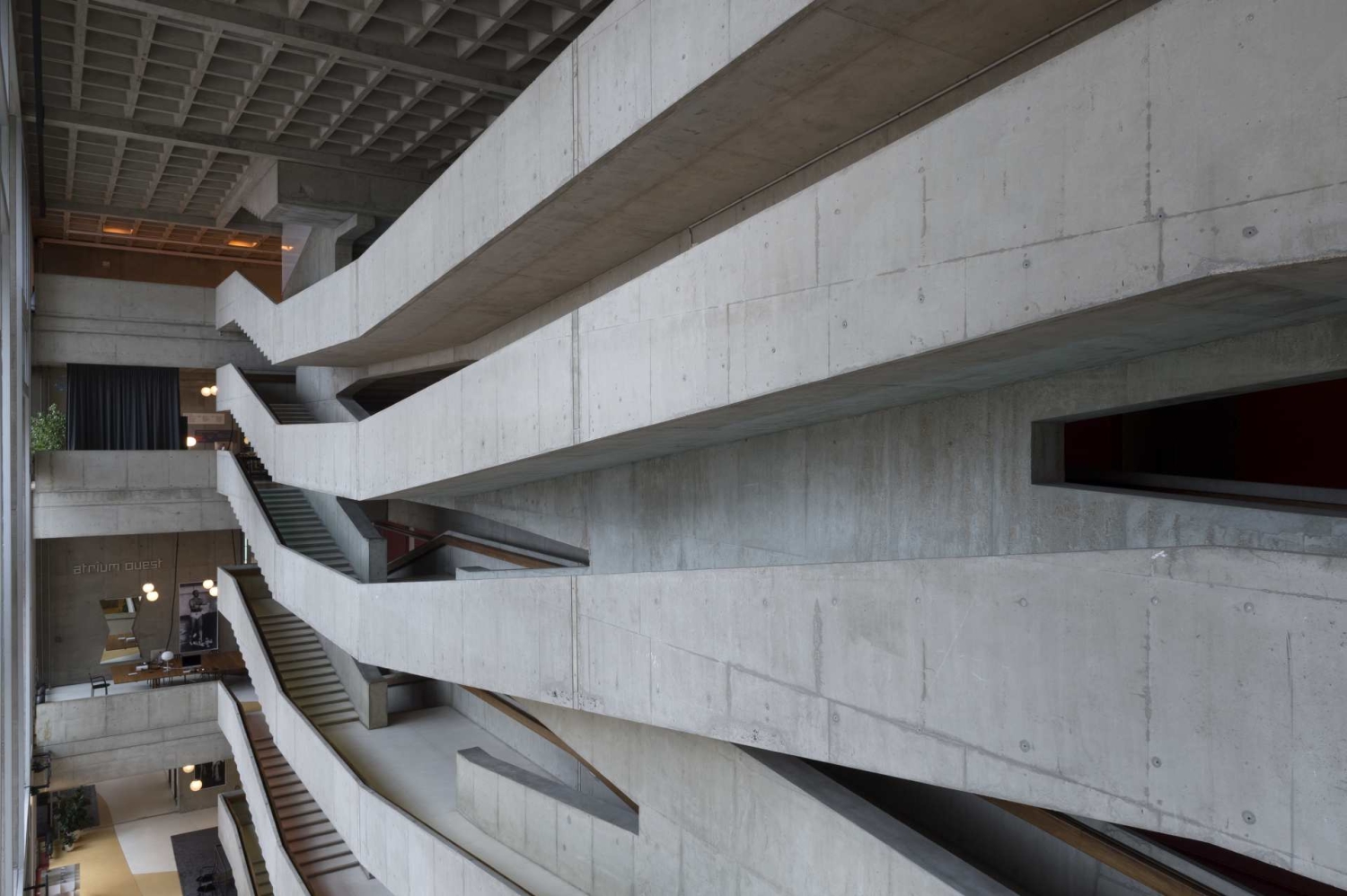
Located on the banks of the ‘canal de l’Ourcq’, the building that used to house the administrative centre of Pantin was built in the 1970s by the architect Jacques Kalisz.
Typical of large institutional buildings built on the outskirts of Paris, this large building is composed of a façade made of raw concrete and a dilated inner space featuring significant volumes and large public spaces organised around a central atrium.
In keeping with the vision of Le Corbusier, defining architecture as “the masterly, correct and magnificent play of volumes brought together in light”, the 2 architects involved in the rehabilitation, Antoinette Robain and Claire Guieysse, took hold of that colossal structure and were required to renovate the various spaces to accommodate the needs of the Centre national de la danse. For such redeployment, they won the ‘Prix de l’Équerre d’argent’ (Silver T-square Prize) – considered very prestigious – in 2004, the same year that it opened.
Equipped with 12 dance studios including 3 that can accommodate the public, a media library, a film library, a screening room, several meeting rooms, an editing room and rooftops with a stunning view of the East side of Paris, the Centre national de la danse is a symbolic site where action is based on a permanent flow between creation, distribution, heritage, training, information and advice to professionals, and access to choreographic culture: an art centre dedicated to dance.
Close to Lyon-Perrache train station, along the Saône river, the CND Lyon/Rhône-Alpes consists of 3 dance studios and a meeting room, combining historic walls with high-end facilities for professionals.